
Every mOst project is built with a neighborhood, a group and local partners. Our method is not a rigid program that we would apply the same way everywhere. It is a shared grammar: steps, principles and tools that make it possible to build a coherent project while staying attentive to local realities.
step 1
meet, listen, investigate
Before making anything, we take the time to understand. We meet local organizations and key people, walk around the neighborhood, and take note of the places, uses, tensions, changes and stories already there. This first phase lets us formulate a starting question that is not imposed from outside.
The inquiry can take the form of conversations, exploratory walks, sensory maps, collections of family photographs, archival research, street interviews or in-depth interviews. It also helps define the conditions of the project: who to work with, what pace is possible, which languages are spoken, which spaces are accessible, which permissions are needed and what forms the public presentation could take.
step 2
share the tools through practice
We quickly put the tools in participants’ hands: film or digital cameras, sound recorders, video cameras, notebooks, maps, pencils, display materials. Technical input is short, concrete and immediately put to the test in the field.
Learning to frame, record, interview, write or draw is not just about mastering a device. Every gesture involves a choice: where to stand, what to keep in the frame, how to listen, which question to ask, which words to use, who to speak to. Passing on technical skills thus becomes an education in looking, and in the responsibility of representing others.
step 3
make things together
The workshops follow a progression. The first explorations produce raw material; the following sessions are used to revisit it, add to it, connect it and build a story. Images, sounds, texts, maps, drawings and archives gradually become the elements of a shared form.
Making things together means sharing decisions. Participants choose the subjects, the people to meet, the images to keep, the sound excerpts to play, the words that go with the work and any limits on how it is shared. Disagreement has its place: it lets us discuss representations rather than hide their complexity.
step 4
edit, curate and prepare to address the public
Raw material is not yet an exhibition, a film or a publication. It has to be selected, ordered, captioned, edited and put in context, and the visitors’ path has to be imagined. This editing and curating stage is central, because it makes intentions visible and turns a collection of pieces into a shared story.
We support participants as they discover how curating and engaging audiences work. They can write the introductory text, choose a title, think about how to hang the work, record a voice-over, design a tour or present the project at the opening. So engaging the public is not an explanation tacked on at the end: it extends the agency of the people who created the work.
step 5
share back in the neighborhood
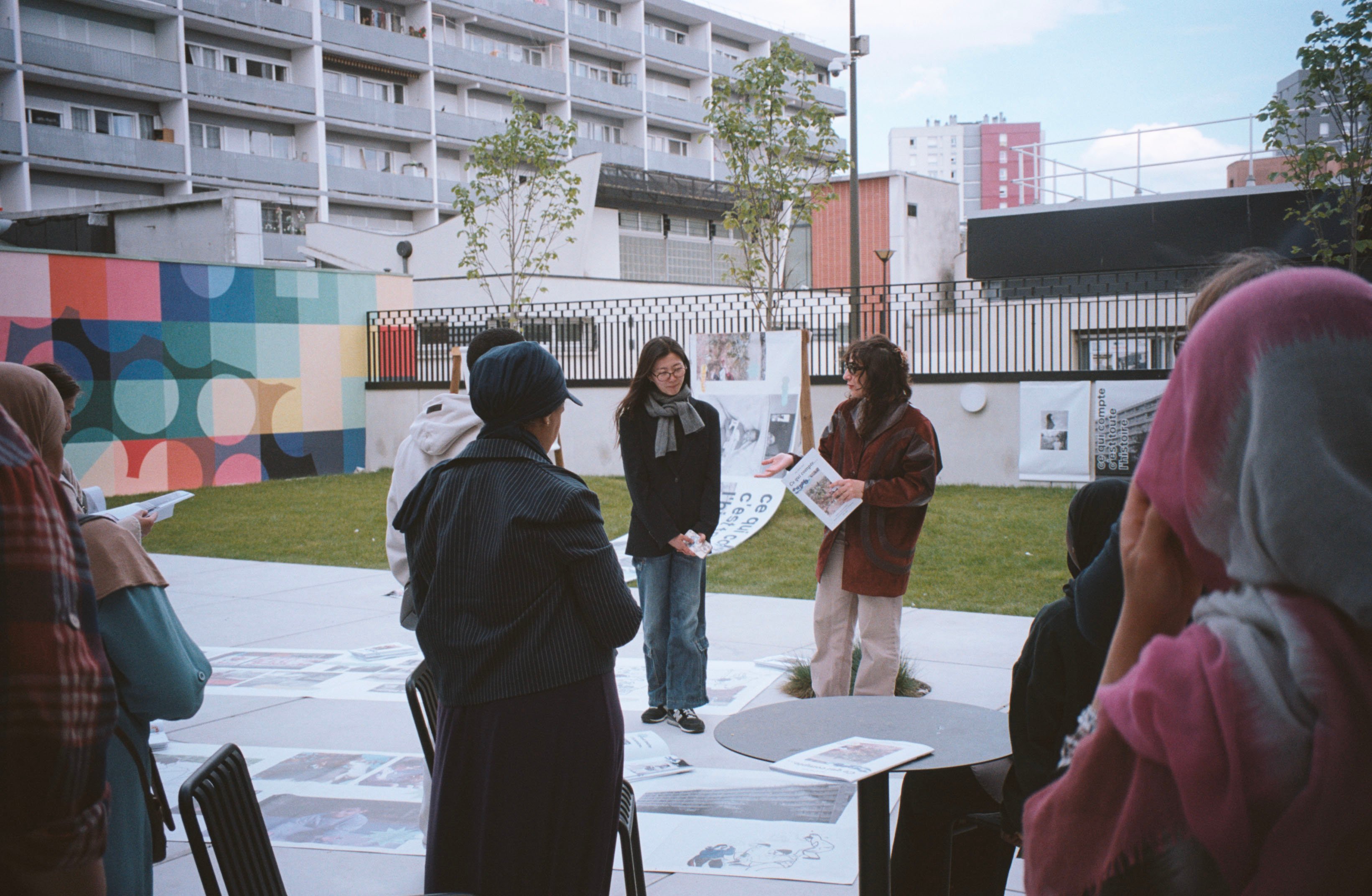
The work first returns to the places where it was made: concrete decks, streets, squares, building entrances, community centers, libraries, cultural venues, shop windows, screening rooms or online spaces. We choose venues based on how people actually use them, and on whether the presentation can reach people beyond the workshop group.
Multi-site exhibitions, films, publications, installations, walking routes or sound archives become spaces for discussion and recognition. Sharing back lets residents see their stories take a public place, lets partners share the road traveled together, and lets the neighborhood come together around a shared creation.
step 6
leave a trace and build continuity
Every project should leave a useful trace: a body of photographs, interviews, a film, an exhibition that can be shown again, a booklet, a map, a teaching guide, a digital archive or stronger local skills. With partners and participants, we work on preservation, usage rights, access to the work and the conditions for bringing it back out.
Continuity is also about relationships. mOst seeks to come back, go deeper and connect projects rather than multiply one-off visits. A first Point of View can lead to a residency, an inquiry can become a living archive, a local exhibition can enter into dialogue with another neighborhood. This long-term presence builds trust and lets the forms evolve with residents.
what guides our choices
- AccessibilityPeople must be able to make the tools their own with no prerequisites, whatever their age, technical skill or relationship with writing.
- High standardsMaking a practice accessible does not mean watering it down. We care about the quality of the images, sounds, texts, publications and public presentation.
- ReciprocityEveryone must be able to decide what they share, what stays protected and how their image or words will be used.
- RootednessLocal partners know the rhythms, resources and vulnerabilities of the neighborhood. We build with them rather than taking their place.
- CirculationStories are meant to come back to the neighborhood, but also to travel, meet other audiences and connect peripheries with one another without erasing their differences.
- The long termWe favor relationships that can last, build a shared memory and have effects beyond the immediate public presentation.